Well, I’ve done it. I’ve run a sequence at 100FPS. (And I’m pretty sure nobody will notice. Sometimes you just do … stuff. For … reasons.)
Last Year
Last year, I wasn’t happy with how the whole house effects looked; they just weren’t smooth. This point was driven home when we went to see the excellent Christmas on Runaway show (which is the nicest one for many miles, has a real megatree, moving heads, and all of that) and thought it seemed a good bit smoother than mine. So, I wasn’t really getting 40FPS, and also set my sights on getting clean 40FPS and 100FPS if possible.
Changes
When the show isn’t clean, there can be more than one problem… sequence issues, player issues, network issues, controller issues, pixel issues. Primarily, my problems were the player and the controllers.
xSchedule was letting me down. I had noticed it was better if I didn’t have remote desktop active, but still some days were better than others. And maybe there were issues with that laptop, too. Both got changed out, and the new stack reports the frame times and packet delivery more thoroughly. I’m glad I did this, as I have 2x as many channels this year, xSchedule certainly couldn’t have done it.
Controllers weren’t displaying all the frames. I ran a variety of lab tests to see what the controller capability really is. I was running some HinksPix PRO v1 and v2 boards, and those have somewhat tight limits on what they can do at 40FPS; swapping them to v3 boards allows 250 pixels per port at 100FPS. The BBB-based controllers do over 300 pixels/port at 100FPS, and the Baldrick 8s do 300 pixels/port at 100 FPS. Due to the 2021 chip shortage, I have only a very small number of Falcons (F16v4 and F48v4), but they do well over 100 pixels/port at 100FPS. The other controllers that I was using didn’t make the cut … weren’t able to display all frames at 40FPS, let alone 100. Those got kicked out of the show and are sitting in a small pile in the basement awaiting their fate… if new firmware won’t fix them, I’m tempted to put some K32Max or similar boards in them.
I had some pixel strings that were longer than those supported by their controllers, but not many. (In 2021, when I started, I had the mistaken impression that the pixels used .6W-.7W each and that I’d need one controller port per 100 pixels, so I’ve always run a lower number of pixels per port.) There were a few places where I had 1 port on a single 350-400 node prop, but I added plugs.
There are still some exceptions. My new P5 panel does not handle over 40FPS. I had to set the player software to deliver frames to it at most every 25ms. Likewise, I have set the controller that feeds the P5 tombs to 1 frame every 20ms, but they don’t show any real problems when hit with too many frames, so maybe that wasn’t necessary.
Conclusion?
I hope you get some amusement out of this endeavor… putting many hours into something nobody else notices or cares about is part of the pathology of the hobby :-).
Been a quiet year here at Merry on Cherry, without a whole lot of time for new things.
P5 Panel
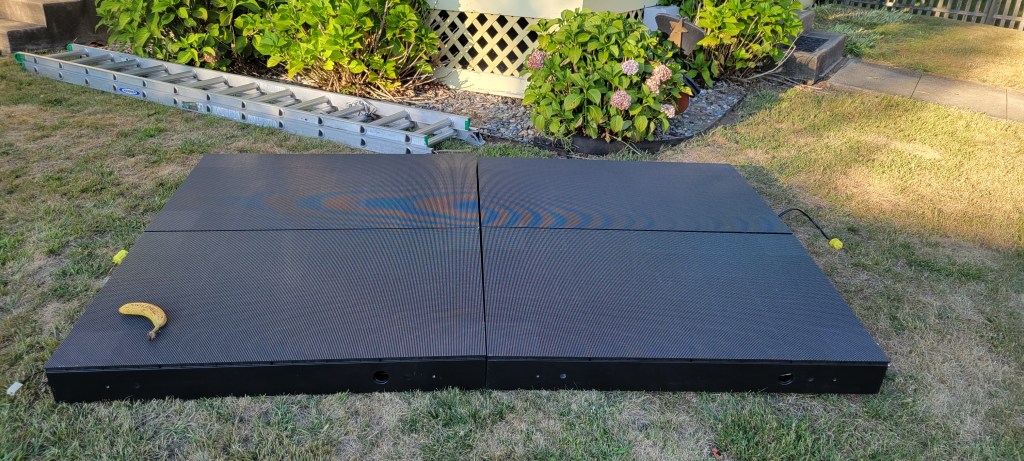
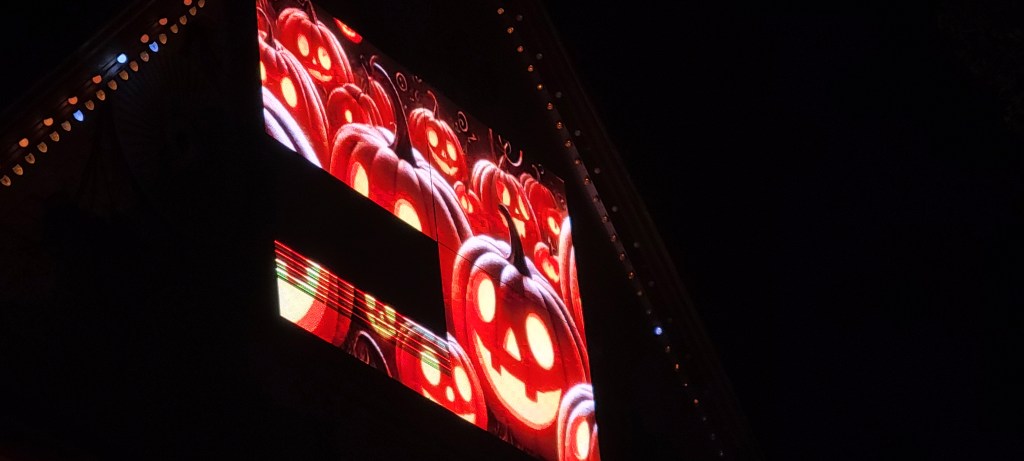
The big addition for the year is a P5 panel to replace my pixel strip matrix. I got the custom prebuilt modules via Your Pixel Store. It’s 8×10 panels overall, so I thought having it made as 4 cabinets of 4×5 would make it easy enough to install myself.
This was incorrect, but fortunately Shay and Noah from SBL Painters came and helped me out of the jam.
Of course, each year also seems to require a misadventure. The panel worked in testing on Aug 31, and through the following weeks… but failed on 9/28. An industry veteran tells me this will be a faulty PSU (and even which one)… on Tuesday we’ll find out if he’s right (I’ll bet he is). (Tuesday update: because he was exactly right, I can say that this was Kent from ACL & KR Lights.)
Smoother Playback?
Every year I say I have perfected my controller fleet, and only to end up with a “do over”. (Last year, I got rid of all smart receivers and went to 1Gbps networking, thinking that would settle things for a few years. Nope.)
I’ve been thinking for a while that other people’s 40FPS looks cleaner than my 40FPS. So, I started an investigation and found more than one problem. Also, as I hardly ever go over 300 pixels / port, and can make adjustments to get below that, I am considering going to a higher frame rate to make the whole house effects a bit smoother.
Anyway, I broke out the high-speed camera (ok, fine, I just used slow-mo on my phone) to see if the controllers are doing what they should be doing. Not all of them were. Normally, I would ask vendors if they had any comments on the results before I shared them, however this time I think some would have said no, so I’ll just pull the punches a bit and only confirm the good results (where the board meets or exceeds the vendor’s specifications). If a popular vendor / controller design is not listed here, and you know I have those controllers, it probably flunked the tests… probably didn’t even do what it was supposed to do at 40FPS.
FPP-based BBB capes. These do very well, perfect 100FPS at a bit over 300 pixels per port, on 32 or more ports. Those can stay in the show, for sure.
Baldrick 8. The vendor does not rate these for 100FPS, just claims “750 pixels/port at 40FPS”. However, they do 300 pixels / port at 100FPS very well. (Close the web page or it will drop a frame every now and then.)
Falcon v4. The vendor says to ask support to set expectations about 100FPS, but I didn’t bother. They’ll do over 100 pixels / port, maybe 150 pixels / port at 100 FPS easily enough, so it meets their claims. They may do more pixels / port than that, there are quite a few advanced settings that might help here, but I didn’t inquire or try them.
HinksPix Pro v3. The vendor makes no claims at all about support for 100FPS, but it turns out that it works reasonably well… 250 pixels/port for 32 or 48 ports is fine (I don’t have a box with all 80 ports populated to test).
Anyway, those results led me to replace (or at least temporarily sideline) a few controllers. Not to worry, replacement 16- and 32-port BBB capes are ready for action now.
Playback Software
It’s finally time to ditch xSchedule. I lived with the quirks and bugs for the last 4 seasons, and it’s part of the reason my playback is not as smooth as everyone else’s. So, this year I’m switching to a new player… because nothing says “adventure” like a new pre-alpha player.
Coro Props?
Frankly, I’ve got most of the coros that I need, and I’m running out of display and storage space. However, I picked up a few replacement snowflakes to take over for the EFlake-450s. (There was nothing wrong with the EFlake design, but they had the misfortune of being pushed with 2022 pixels, and those were starting to fail. The x-flute coro just holds them too tightly for replacement to be worthwhile, so I got some new flakes from Boscoyo and GE.
I liked the way the P5 tombs turned out, so I got some stockings. Will put them up… somewhere…
To fill a small hole in the hedge, I grabbed a couple of these from the new line of coros from Wired Watts. They’re quite well made, a relative bargain at $11 each for full color printing with wiring diagram on the back.
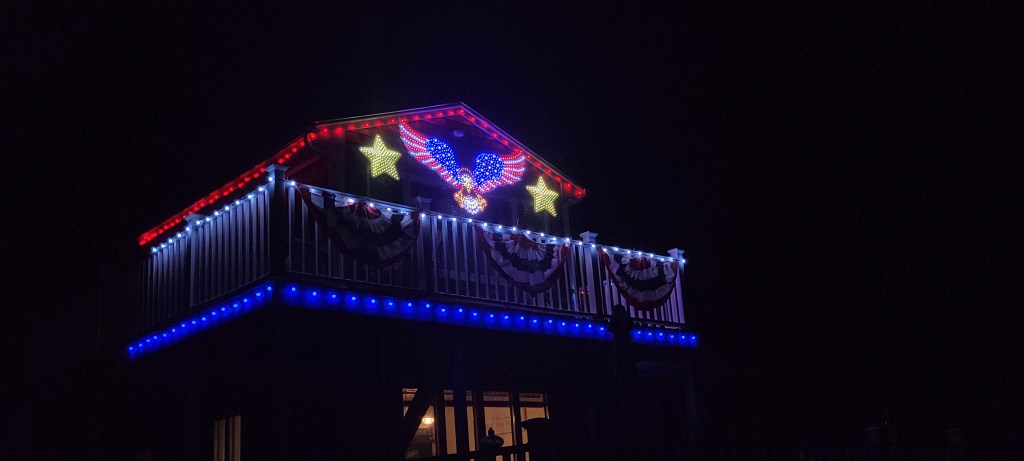
The main thing I’ve been doing is picking up some patriotic coros, hopefully to be used for the 4th of July next year. (That Boscoyo eagle … I think it looks pretty good up there…) I got quite a few from Pixel to Prop (they have a good selection of stars and spinners in red, white, and blue), and a few from GE (USA letters, armed forces cutouts).
I do also have a waving snowman and a few other items from EFL… but what pixels will I use for that?
Best Pixels For Coro?
As I was last year, I’m on the hunt for better pixels for coro. I have lots of 12mm resistor bullet pixels, but am always looking for something more efficient, lighter weight, with a softer look. (And yes, more reliable than those 2022 pixels. A lot of the newer pixels are a single LED module made and soldered 100% automatically, which at least has the potential of being more reliable.)
GS8208 bullets (e.g. YPS Duo). These tick the box for higher efficiency, and they’re super bright. But they’re still bullets in terms of size and weight, and they have the high manufacturing complexity of a PCB with a main chip and several passives encased in epoxy. They have a mind of their own when powered with no data signal, which is also a bit weird. Keep to well under 100 from power. I use them when I want their sheer brightness, so some of the 4th of July stuff uses them.
WS2808 bullets (Wally‘s). These are also higher efficiency and run a couple hundred pixels from power. The brightness is about the same as resistor bullets. These are a significant efficiency upgrade from WS2811 resistor bullets, but they are a complex product with a lot of passives on the PCB, and are still the same size and weight as bullet pixels. I’ll be getting more for those cases where only bullet pixels will do.
Gumdrop (Wally’s Lumidot). These are much lighter than bullets and are also high efficiency. Much softer look. These do bleed through white coro (which can be good or bad, depending on what you’re going for), but the big issue is they fall out. They work great in ChromaTrim and a few other things (probably tree strip), but for general usage in 10mm coro, they’re not great. I really do like the look, so I’m getting some custom coros with undersized holes. We’ll see.
Gumdrop (MLS Magicolour). These are also light and efficient and have a gamma of only 2.0, but are not tall enough for 10mm coro… probably a great candidate for tree strips and HDPE matrix.
Gumdrop (EZRGB or ScottLED). These are nice and tall, do not bleed into coro much, and are efficient and lightweight. Somewhat dimmer than the rest, and only set for coro of 10mm thickness.
Gems / Blackouts (YPS or similar). These are very light and efficient, run 200+ from power, and fit well in 10mm coro. Cons: Unless you pay a little more for blackout, they bleed into the coro. Less viewing angle, and somewhat weird color mixing – tend to look a touch blue or orange depending on what side you look from. Great for high density.
There are a few other offerings I’m keen to try… but can’t get ahold of just yet. EVO Domes come to mind, but sadly, Mattos preorder schedules don’t line up with my show very well.
So, the best depends a lot on the situation. Seems like resistor-based bullet pixels still may have some life left… especially at the new lower prices this year from ScottLEDUSA.com.
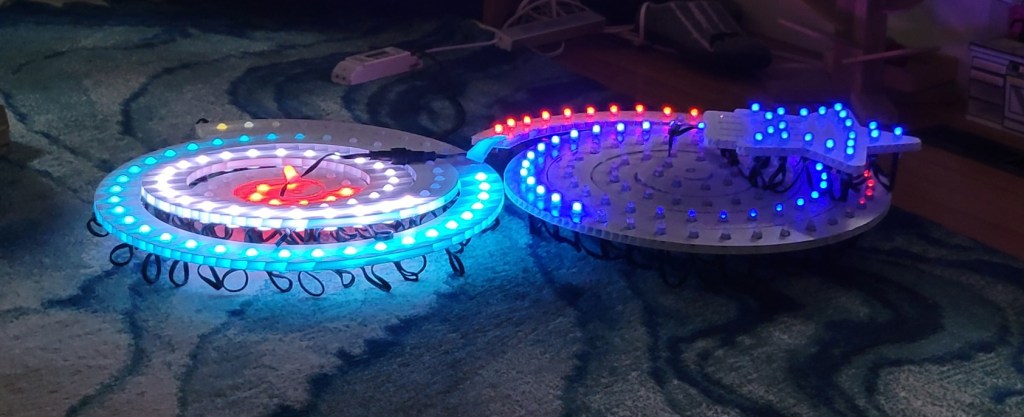
I think the coro bleed has the potential to look pretty cool … a bit softer. Gilbert Engineering was nice enough to custom cut some spiral trees with tighter holes for the lumidot pixels… see lumidot on the left, vs resistor bullet on the right. It worked out pretty well.
Seed Pixels?
I’m working on a seed pixel flag, intended as 40 strings of 250 2″ spaced seed pixels. The custom HDPEs have arrived from HolidayCoro, and they are amazingly clean-cut… now I just need to put the 10,000 pixels in.
Additional matrix and tree projects are ongoing… but they won’t make it for 2025. All of this is for 4th of July 2026 (hopefully).
3D Printing?
Still on the “to do” list is some sort of frame for last year’s seed pixel mini trees, to hold the cone into a more conical shape. Updates as warranted.
P4 Panels?
Last year, I got some flexible P4 panels, but never got them to work. Hoping the new PB2 panel cape from Kulp will be the ticket, since it has the ‘E Line’. We’ll see.
Sequences?
Yes, there will be new sequences. No spoilers! (Actually, I’d tell you, but I simply don’t know what they’ll be yet.) I will be using EZSequence for as much as possible this year, though I will probably resort to reimporting last year’s sequences again to keep sufficient variety.
Bitrex?
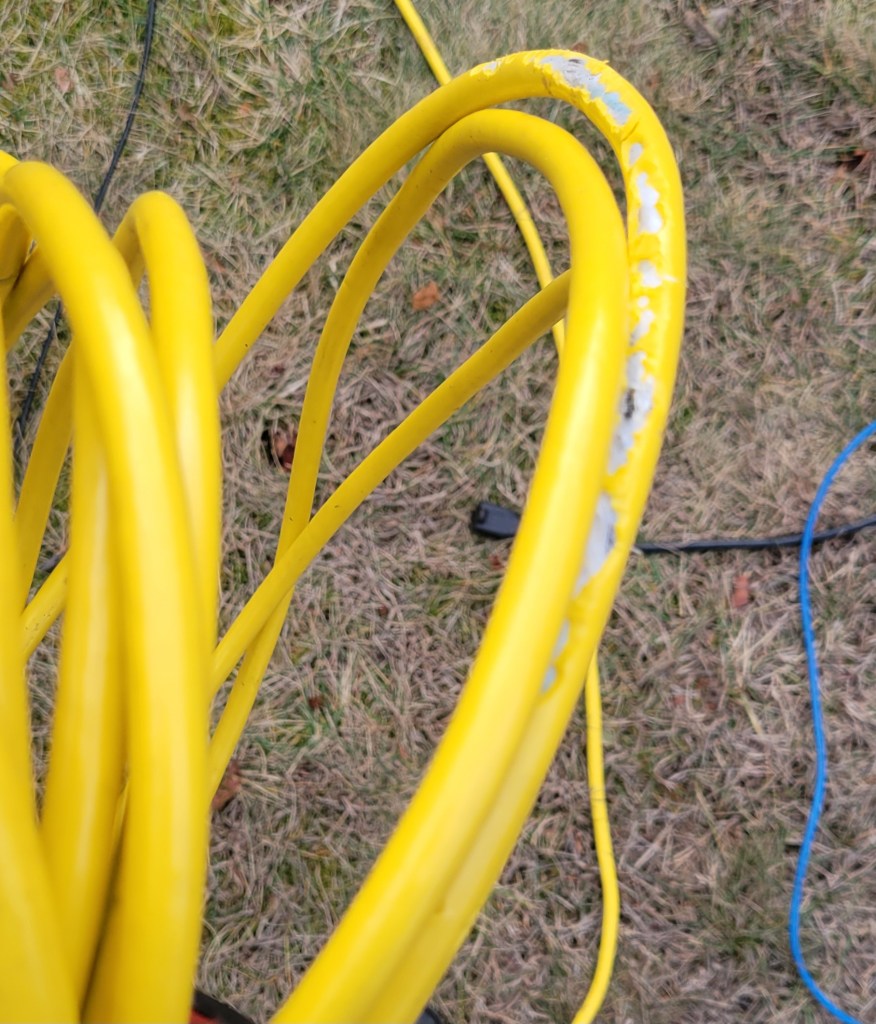
There seems to be a rabbit nexus under the hedge. They took nibbles out of each of my extension cords… the yellow ones, white ones, pink ones, green ones.
They only thing they didn’t bite, as near as I can tell, is the cheapest black ones. But enough about the past… this year I will spray them with something bitter and report back as to how it went.

 Merry On Cherry
